
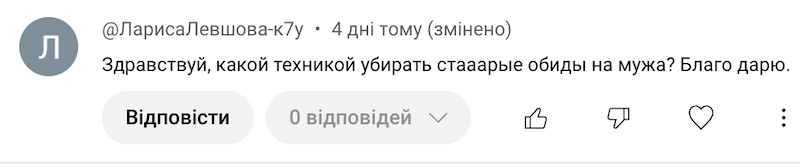
What technique can you use to remove old resentments against your husband?


This question was asked to me in the comments to one of the videos on my YouTube channel (you can find the link to the video below). I decided to write my thoughts on this issue because the question is relevant, the topic is urgent, alive, which definitely triggers many and is familiar to many too.
I want to start by saying that the question itself, the way it’s phrased, already has a lot of answers. So I want to break down this question literally into molecules to give you the most important technique – how to find answers in your own questions.
What is resentment?
Resentment is a complex feeling that consists of two emotions – pain and anger. Have you probably heard that children or the weak are usually offended? This is the essence of resentment – when either there is no right to place anger on the offender, or there is not enough strength to be angry. This makes it painful, and therefore – both.
And what does a wife do when she resents her husband? After all, in marriage, according to the idea, both partners should be equal, that is, both are adults? And if one partner somehow, maybe casually, offended the other partner, then you can simply say about it – you hurt me, and receive an apology from the offender. But this rarely happens, much more often – one offends and does not notice it, the second offends, but somehow cannot do anything about it. And the aggrieved person sometimes carries his grievance for years, and the aggrieved person does not understand what is happening – why he is offended, because no one explains anything. Therefore, here is the first technique for you:
Technique for working with both – tell the other person about it
So, first try to tell about your grievance. If it is difficult to talk about it – ask yourself – why? What stops? Shame? Fear? If you are ashamed, what are you ashamed of? Is it a shame to show yourself weak and helpless (after all, according to stereotypes, the strong offend the weak, and perhaps it is you who cannot bear to see yourself weak)? If fear stops, then what are you afraid of? What devalues your feelings? That they will say something like – did you think? What can offend even more?
To say out loud to another person that you are hurt, that you are angry, that you are offended. Calmly explain why you are hurt, you are angry, you both care. Try to say it all, using “I” instead of “and here you are.” You speak for yourself. And look at the reaction. And draw conclusions.
My videos are about both
Remove both – who can do it?
Let’s go back to the question from the comment – there you will find the verb “remove”, and note that the question is put in such a way that it is completely incomprehensible, and who exactly should remove both? After all, it sounds as if someone else should do it. And also in this wording there is a feeling that both are something dirty that must be removed, like garbage, or hidden. Of course, in some way this is so, if we are talking about a family where we would like purity and openness.
But who in the family is responsible for cleanliness and order, including emotional? Is this a husband? Or a wife? Or both? Or someone outside? After all, the author of the question did not ask – how can I remove MY offense against my husband, the author wrote detachedly – as if it were someone else, let him do everything for her. And it doesn’t work like that. And here it is important to ask yourself – what can I do so that there is no resentment between me and my husband? What can I do so that they do not feel resentment towards their husband? You see, when you formulate a question in this way, your responsibility appears, which means your power and control over the situation and your feelings. This is very important to understand.
Old grudges against the husband
There are also words in the question about the fact that both are old, and this also touches me. First of all, it turns out that there are old ones, and there are also new ones? And how do the new ones differ from the old ones? And why do you need to clean the old ones? There is a bit of irony here, I agree, but still – how old are the old men? Or maybe a ten-year-old? This is not the main thing here, but what – why was the man resentful of his husband all this time? What did this offense give? What did you replace? Or who? Who or what is she in the triangle of relations? What does it protect from? All these questions would be good to ask in the course of individual psychotherapy, so just in case, I am leaving a form to make an appointment with me for a consultation:
How to remove both on the husband?
They always told me – they carry water for the offended. I drew conclusions and decided to immediately show my anger to the offender instead of obida) There is a bit of irony here, but you know, I like the idea that obida is not a noun, but a verb. Offense is making such a choice. The choice will be offended. But agree, a person chooses – carries a grudge against a close person for years, or goes to psychotherapy in order to learn to understand himself and find ways to express his needs and feelings to other people. What you do with yourself and your life is your choice.
Offense, as a reaction to someone’s words or actions towards you, is a normal reaction. Resentment that has been going on for several months/years/decades is your choice and your way of living like that. And you either like it or you don’t.